
Recent Posts
-
gayhighwaymen
- Sights seen at International Mr. Leather in Chicago
- Rats! For real. Sight seen at IML.
- Noh Gaze Aloud…don’t be Meme!
- Gay Highwaymen correspondent AidanAbroad sends pics from China…
- Married at last! Gay pair make it official on 30th anniversary…
- Island hopping…
- Mussel Otter wants to…
- I know you like poke…
- Water bags for water boys?
- Inky gods’ stray musings from the Prophat of the Church of More Men…
-
Maštíŋčala Sáŋ
- Spiny Lumpsucker
- Gay Activism and Iran: Do Western Activists Do More Harm Than Good? (Link to article by Scott Long)
- Emigrant: The Other White Meat?
- Obama Loves Queers! (Except Not)
- Hot (the bad kind) in the Mission
- HuffPost Gay Voices: Liberian Anti-Gay Group Issues Hit List, Governments Do Nothing
- Exotic, Fresh, and Fruity: Seen at the Asian Market
- Deadly Beauties
- More boy love/lust graffiti in SF
- “I WHAT Cock?” – Construction Sign Self-Expression
-
Tag Archives: Art
Homotextual Slide Show: Obey Milk Now, Christian Underpants, and…
…other sights and signs seen in the Castro District and other assorted San Francisco City sites. For more homotexuality, click here and here.
Posted in Photography, San Francisco, Signage, Street Art, Grafitti, etc.
Tagged Art, Castro District, Culture, Gay, Photography, San Francisco, Sexy, Signage, Street Art, Grafitti, etc.
Yaoi Bara Manga & Gai Comi influenced New Cali Gay Leathersex Art: JoJo Mendoco
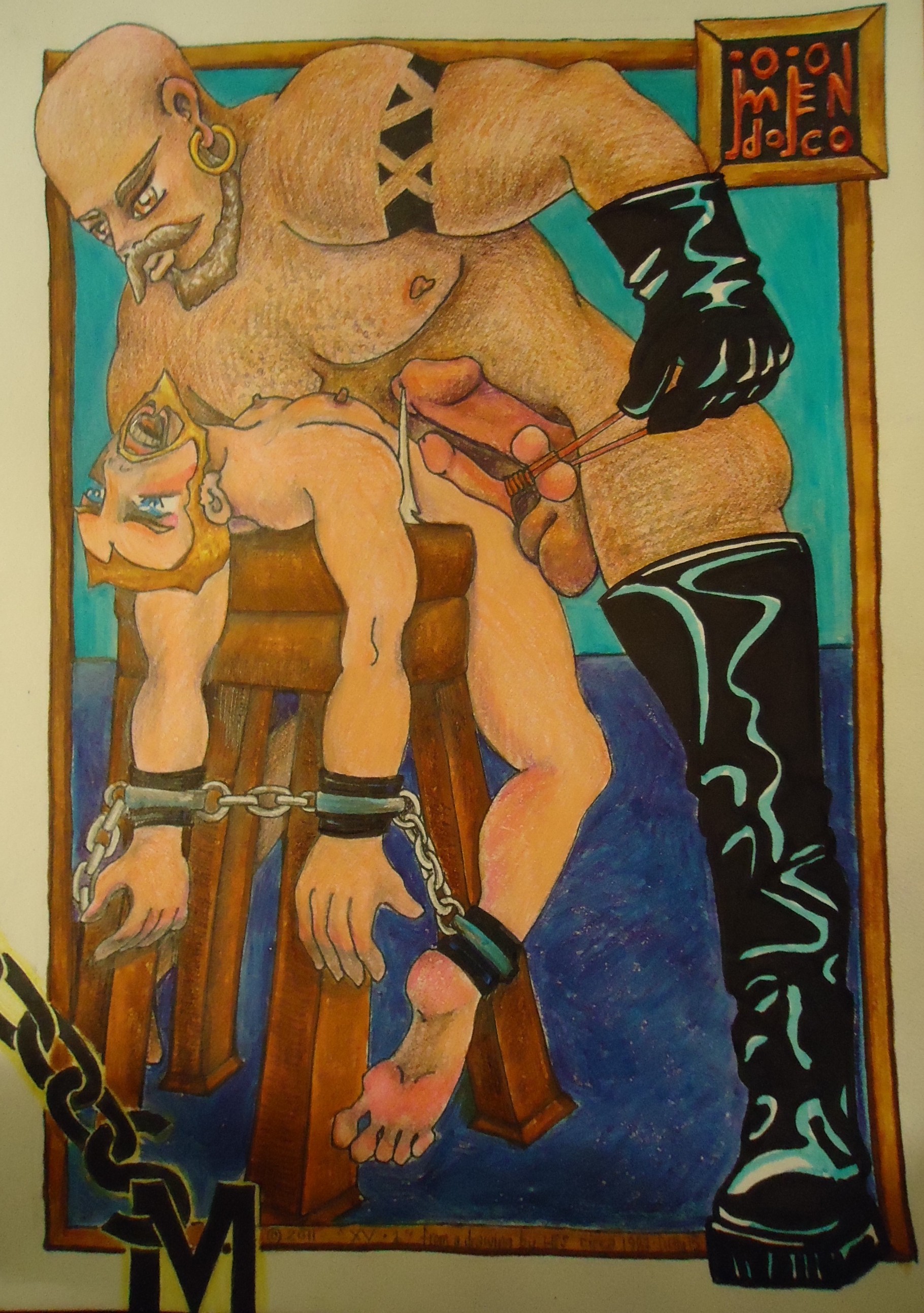 This is new from JoJo Mendoco. “XV.1” 2011. Mixed media on paper. Based on a drawing from 1989 by “Les” for the 15 Association, San Francisco. Influenced by Japanese Manga forms and European and American 20th century gay erotic artists. Want more? For a red-headed bukake boy, click here; for a hot two-on-one: here.
Living on a Fault Line: SF Shibari Relief – Kinky Artists to benefit Quaked Japan
 Last year, Chile. Last month, New Zealand. Last week, Japan and now its aftermath, ongoing. What next? Who knows. What now? Do what we each can. In that spirit, a loose group of kinky artists in San Francisco are presenting Shibari Relief: “We know what it’s like to live on a fault line.”
From their website: “Mark I Chester and Patti Beadles are organizing Shibari Relief. There will be a silent auction/sale and raffle of BDSM art, sexual art and other related items. There is no door fee, but a suggested $20+ donation can be given at the door. No one will be turned away for lack of funds. 100% of the proceeds will go to the American Red Cross earmarked for disaster relief in Japan.
As a special added bonus, anyone making a donation at the door will get a ticket to get two free digital pix taken by San Francisco gay radical sex photographer, Mark I Chester at his studio at 1229 Folsom St., just 1/2 block from Wicked Grounds, from 3-5pm during the fundraiser.”
Shibari Relief takes place in San Francisco at the kink-oriented Wicked Grounds Cafe at 289 8th St. on Sunday, March 27, 2011 from 2 – 5 pm.This is an all orientations and genders event. Artists who may be of particular interest to readers of this site include Mark I. Chester, Charles Gatewood and Michael Rosen.
Artists interested in contributing to the relief effort can contact Mark I. Chester through his website.
Posted in Collecting, Japan, Leather, San Francisco
Tagged Art, BDSM, Culture, Earthquake, Fundraiser, Gay, Kink, Leather, LGBT, Mark I. Chester, Photography, San Francisco, Sexy, Shibari Relief, Tsunami, Wicked Grounds
Richard Bolingbroke’s Personal Encounter with a Video Storm
San Francisco artist and friend of this site Richard Bolingbroke recently visited a video installation at the exhibit Breathed…Unsaid…Exploring Personal Encounters with Cultural Diaspora at San Francisco’s Somarts Gallery. He took photographs of his shadow playing across the screen to produce these King Lear-like images: a solitary figure in silhouette, seemingly struggling with the burden of power – or maybe just raging against the oncoming storm. For more on Bolingbroke and his more typical methods of art-making, click here and here.
Posted in Art and Artists, Richard Bolingbroke, San Francisco, Video
Tagged Art, Culture, Gay, Richard Bolingbroke, Somarts, Video
Top o’ the Morningwood to You!

JoJo Mendoco 2011
A JoJo Mendoco original, inspired by Japanese comics: yaoi bara, gai comi and manga in general as well as Western gay erotic artists such as Etienne. For the 2012 St. Patrick’s day offering, in which a rough sex leprechaun sticks it to a Brit boy, click here. For lots more JoJo Mendoco, here.
Posted in Art and Artists, Comics, GAY GAZE: Visual Culture, Photos, Art, Comics, Film, Objects, etc..., Ireland, Japan, Leather, Sexy Holidays
Tagged Art, Bara, BDSM, Comics, Gay, Irish, JoJo Mendoco, Kink, Manga, Sexy, St. Patrick's Day, Top o' the Morning, Yaoi
Happy Sexy St. Patrick’s Day!
 This hulking leprechaun is via the Muscle Manifesto blog. Origin and date unknown. Digital media…no pens and pencils here…all pixel-pushing and paths.
For other Sexy Holidays, click here, here, here and here. There are plenty of others in the Sexy Holidays category.
Posted in Bodybuilding/Muscles, Comics, Ireland, Sexy Holidays
Tagged Art, Bodybuilding, Comics, Culture, Gay, Holidays, Ireland, Irish, Muscles, Sexy, St. Patrick's Day
Mardi Gras in New Orleans: before the Krewe of St. Anne Procession
The Secret Society or Mystic Krewe of St. Anne is a walking club that was formed in response to the 1969 ban on rolling parades in the French Quarter. It is known for the elaborate costumes of the creative core group, which gathers before the march in the Bywater district. That group is joined by other parties along the parade route, which winds through the Faubourg Marigny and the Quarter. Here, sights seen before the march. Much more on Mardi Gras, tossing beads at boys and our gracious party host. Just click the links.
Where Yat Magazine says of St. Anne:
“The Society of Saint Anne is one of the best not-quite-kept secrets. Those in search of beads, breasts and beer best stay by Bourbon Street, as they will not appreciate the beauty and pageantry of this walking club. But those needing a respite from the unimaginative verbal assaults, the stench of urine and groping crowds need only walk one block out of the Quarter on Tuesday morning.
The R Bar, at the corner of Royal and Kerlerec, is one of the many hosts that will greet, with open arms and libations, the magic. For certain, the Society of St. Anne dispenses magic from its first strut beginning in the Ninth Ward and along its path through the old neighborhoods eager to receive the walking procession’s good cheer.
It is this corner, just outside the Vieux Carre, that seems to marry and unite the neighborhoods on both sides of Esplanade. And for those joining the regalia’s ranks, it is a welcomed culture shock. The wanna-be Mardi Gras of crassness is left behind and replaced by theater. Venetian vintage capes and gowns of velvet adorn those whose identify is masked in the commedia dell’arte tradition. Papier-mâché creatures prance, fairies flit, cowboys and cowgirls ride tall on galloping bicycles, and renegade feathers float among Elvis kings and six foot queens.
The Society of Saint Anne’s wending from somewhere in the Bywater to Royal, and on to Canal Street to greet the Rex parade, has become pretty much public domain – with folks flocking to watch and join in. Those in the know say that sometime during the ‘80s, the procession began going down to the river after viewing Rex. Initially this was to honor those friends within the Society of St. Anne that had succumbed to AIDS. There at the river, their ashes would be tossed into the Mississippi’s currents. This practice of casting the ashes of those friends wishing one last fling with the Society is tradition now.
This Carnival walking club is not always forthcoming about its precisian – it is, of course, a secret society. But in recent years, a few well-chosen interviews have been granted. From these and from guarded word of mouth, certain facts are as follows. In 1969, Henri Schindler, author (most notably of the definitive text, Mardi Gras, New Orleans), Carnival designer, historian and true devotee of Mardi Gras began the Society of St. Anne along with friends Paul Poche and Jon Newlin. The inception of the society began as a reaction to the ordinance that banned the old-line parades from the Vieux Carre.
The naming of this band of costumed marchers apparently was inspired by the trio’s discovery of a tomb in St. Louis Cemetery No.1 honoring the Societe’ de Sainte Anne, a benevolent society founded by the Sisters of Charity. And from the quiet of a cemetery grew a vibrant and colorful tradition.
While this caravan of revelers has grown from the imaginations of three to easily over 2000 costumed participants on Mardi Gras Day, the core group is rumored to number around 200. It is this creative core that plots and plans throughout the year with parties, a rumored ball and extensive work creating the exquisite costumes and their signature hula-hoops flowing with ribbons from atop tall poles.
And while much has been written and discussed of the Society of Saint Anne, make no mistake, this organization holds fast to its tenets – secrecy being foremost. Just ask one too many questions, and you will receive a smile, but with it a coy yet firm “No comment.””
Posted in DIY and Maker Culture, Drag, History, New Orleans, Subcultures
Tagged Art, bywater, Culture, Gay, Krewe, Krewe of St. Anne, Mardi Gras, New Orleans, NOLA, Sexy
Fabulous New Orleans Trash Cans…really.
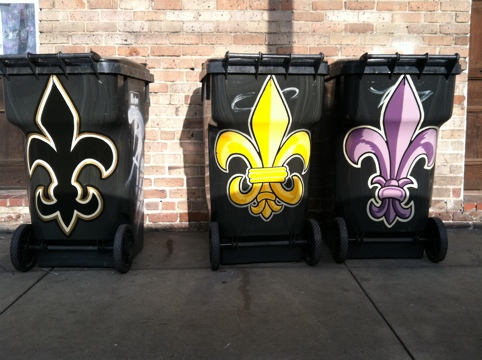
Hand-painted and brilliant. And very New Orleans.
Posted in New Orleans, Signage, Street Art, Grafitti, etc.
Tagged Art, Culture, New Orleans, NOLA, Street Art, Grafitti, etc., Trash Can
Great Gay Leathersex Art: Who was Michael Palmer?
It measures about 5′ x5′ and used to hang in the Jackhammer, an old Leather bar in San Francisco. The Jackhammer has been closed since 1996 and this painting now hangs in a private home. It is signed “Palmer” in the lower right corner. A quick consultation trip to Brand X antiques in the Castro district secured a last name, a look at a couple of prints on sale for a couple of thousand dollars each, and an awful story. The proprietor told us that the artist’s first name was Michael. He had quite an extensive body of work, most of which he held in his studio. When he died in the middle of the plague years, his mother, horrified by her little boy’s adult proclivities, destroyed everything.
This sort of thing happens too often. Wonderful Willie Walker, friend of this site, and founding member of the Gay and Lesbian Historical Society, used to dumpster-dive the estates of deceased gay men whose “families” would throw away their collections in shame. Walker – a hero to gay historians and a legend among archivists of any stripe. We miss you, you little weirdo.
Western art is built on the bodies of naked ladies. They call it “The Nude.” The ancients understood the beauty of the male body. We understand it. But – and this is for artists and collectors especially – the folks might not. Make wills, make bequests, make sure your lover has power of attorney, give gifts to the young gays and make sure the good stuff gets into good hands. Generations coming up will need their history. We are making it now and it is our responsibility to make sure it survives.
Meantime, any information on Michael Palmer, gay artist living in San Francisco in the 1980’s would be much appreciated.
For a bit on Chicago-based artist Etienne, click here.
Posted in Art and Artists, Collecting, History, Leather, San Francisco
Tagged Art, BDSM, Boots, BrandX, Culture, Gay, Gay Artist, History, Homoerotic, Kink, Leather, Michael Palmer, Palmer, San Francisco, Sexy, SOMA, Whip, Willie Walker
Flogging the Peg Boy! Sexy Sailors from London’s Studio Royale.
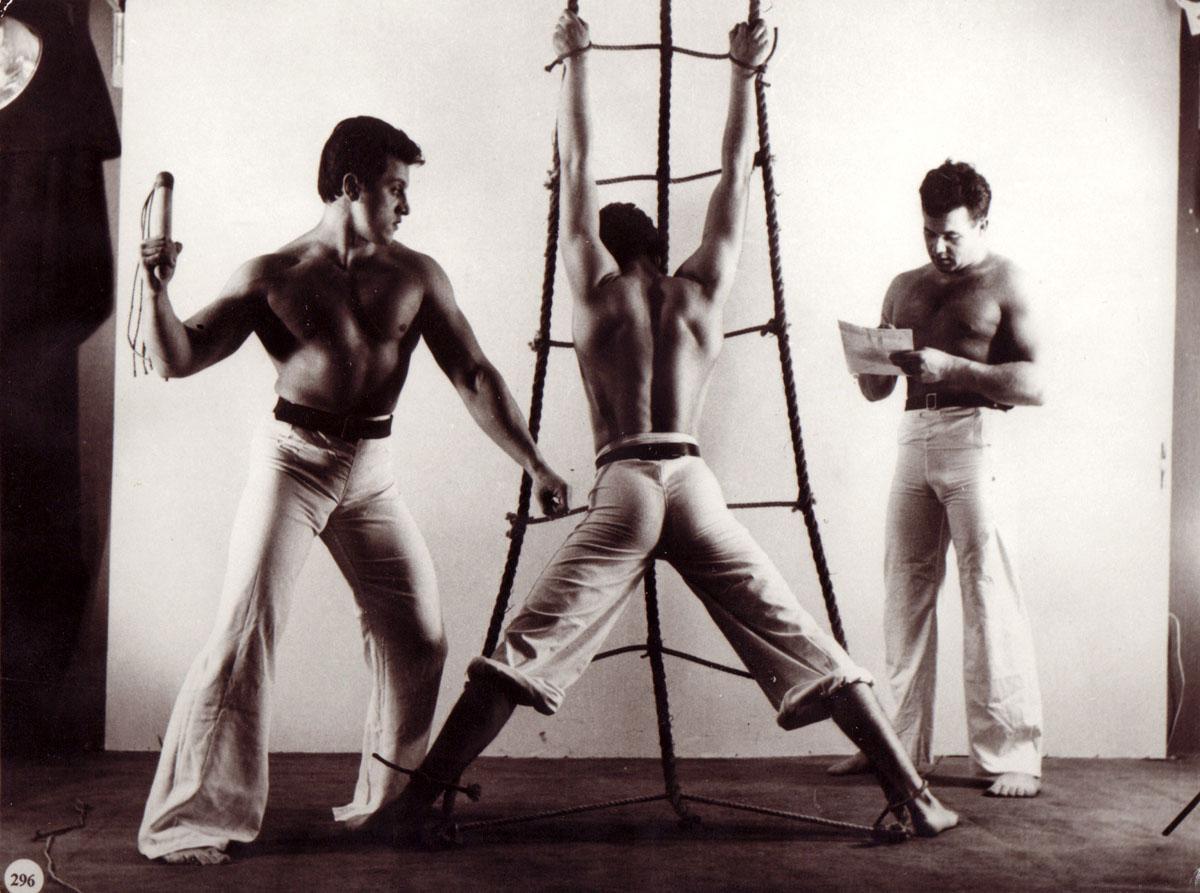 Another interesting vintage photograph. From Studio Royale of London.* It’s got that mid-century film still thing going on and a nice reference to the old law of the sea. Whether in the legitimate Navies or their pirate shadows authority condensed into the will of a single man, the Captain, and was enforced by, among other things…the sting of the lash.
For another mid-century photo, this one of mysterious provenance, click here. For more on homoeroticism on the high seas, check out Hans Turley’s Rum, Sodomy and the Lash: Piracy, Sexuality and Masculine Identity. NYU Press, 1999.
*Thomas Waugh. Hard to Imagine Gay Male Eroticism in Photography and Film from Their Beginnings to Stonewall, New York: Columbia University Press, 1996, page 256.
 The Gay Highwaymen