Category Archives: History

Leather for Condos: San Francisco’s Eagle Tavern forced to close its Doors by the end of the Month.

Neighborhoods change. Once a dozen Leather bars lined Folsom. And then there were none. The Eagle Tavern has been a longtime mainstay of San Francisco’s diverse Leather communities. A friendly, informal place with a large patio, the Eagle has also been unique in being able to support a generous mix of queer subcultures in relative harmony. Sunday afternoons would see Leathermen and drag queens, queer stoners, musicians, hipsters and quipsters all sharing the same sunny patio.
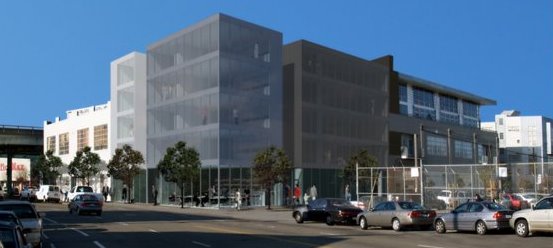
Building proposed for site of current SF Eagle

Now the owner of the building and the site won’t renew the lease. The new year brought rumors that it would be sold to developers, and this latest news supports that. Money talks. The Eagle is a one-story sprawling quirky thing under the freeway. The above rendition is the slick new multi-use building that is proposed for the site. Joe Jervis of the popular gay blog Joe. My. God. said: “I’ve had some fantastic times at the ramshackle, broke down, SF Eagle. Most of my favorite bars have been in that sort of condition.” But when money talks, neighborhoods clean up. Soon it will even be safe for the children. Isn’t that nice?

A community action planning meeting to brainstorm ways to save the Eagle is taking place TONIGHT, Monday, 2011, at The Eagle. The ad hoc committee is organizing on Facebook here. The Eagle is located at 398 12th Street at Harrison, by the freeway.

South of Market has been changing for a long time. For a historical perspective on the shifts, and the political attitudes that shape them them, Leather historian Gayle Rubin has considerable insight. This is from 1989:

“South of Market has been undergoing so much rapid change in recent years that many of its current habitues are unaware of or uneasy about its recent past. The newspapers endlessly repeat a mantra of how brave pioneers — usually restauranteurs catering to an “upscale” crowd — have wrested the area away from the “lowlife” elements that once made the area “undesirable.” This point of view rests on the assumption that it is “right” and “good” when “disreputable” populations such as gay people, the poor, or people of color are displaced by wealthier, whiter, straighter, more “respectable” folk.

Gay “leathermen” are one of the most visible and least understood of the ostensibly vanishing groups of SOMA aboriginals. Reading about the world of leather in the straight press is a bit like reading the reports about indigenous peoples written by dumbfounded missionaries in the heyday of colonialism.

When I see the disappearance of its gay population used an indicator of the South of Market “renaissance,” I am reminded of the ways white settlers in North America spoke of the Native Americans they displaced.”

Excerpted from “Requiem for the Valley of the Leather Kings,” originally published in Southern Oracle, 1989

Updates here.
Goldfield Ghost Town’s Glory Hole and More

This slideshow requires JavaScript.

Glory Hole Antiques, that is. An odd little junk shop with an open door, an interesting inventory, no price tags and no one in sight or within earshot. We put a few dollars in a jar for an old bottle and a small cannonball. Goldfield boomed in the early part of the century, following a 1903 bonanza strike, and was busy until 1940, after which it fell into decline. Few businesses are open or residences occupied now, with vacancy running about 90%. On U.S. Highway 95 in Nevada.

Mardi Gras in New Orleans: before the Krewe of St. Anne Procession

This slideshow requires JavaScript.

The Secret Society or Mystic Krewe of St. Anne is a walking club that was formed in response to the 1969 ban on rolling parades in the French Quarter. It is known for the elaborate costumes of the creative core group, which gathers before the march in the Bywater district. That group is joined by other parties along the parade route, which winds through the Faubourg Marigny and the Quarter. Here, sights seen before the march. Much more on Mardi Gras, tossing beads at boys and our gracious party host. Just click the links.

Where Yat Magazine says of St. Anne:

“The Society of Saint Anne is one of the best not-quite-kept secrets. Those in search of beads, breasts and beer best stay by Bourbon Street, as they will not appreciate the beauty and pageantry of this walking club. But those needing a respite from the unimaginative verbal assaults, the stench of urine and groping crowds need only walk one block out of the Quarter on Tuesday morning.

The R Bar, at the corner of Royal and Kerlerec, is one of the many hosts that will greet, with open arms and libations, the magic. For certain, the Society of St. Anne dispenses magic from its first strut beginning in the Ninth Ward and along its path through the old neighborhoods eager to receive the walking procession’s good cheer.

It is this corner, just outside the Vieux Carre, that seems to marry and unite the neighborhoods on both sides of Esplanade. And for those joining the regalia’s ranks, it is a welcomed culture shock. The wanna-be Mardi Gras of crassness is left behind and replaced by theater. Venetian vintage capes and gowns of velvet adorn those whose identify is masked in the commedia dell’arte tradition. Papier-mâché creatures prance, fairies flit, cowboys and cowgirls ride tall on galloping bicycles, and renegade feathers float among Elvis kings and six foot queens.

The Society of Saint Anne’s wending from somewhere in the Bywater to Royal, and on to Canal Street to greet the Rex parade, has become pretty much public domain – with folks flocking to watch and join in. Those in the know say that sometime during the ‘80s, the procession began going down to the river after viewing Rex. Initially this was to honor those friends within the Society of St. Anne that had succumbed to AIDS. There at the river, their ashes would be tossed into the Mississippi’s currents. This practice of casting the ashes of those friends wishing one last fling with the Society is tradition now.

This Carnival walking club is not always forthcoming about its precisian – it is, of course, a secret society. But in recent years, a few well-chosen interviews have been granted. From these and from guarded word of mouth, certain facts are as follows. In 1969, Henri Schindler, author (most notably of the definitive text, Mardi Gras, New Orleans), Carnival designer, historian and true devotee of Mardi Gras began the Society of St. Anne along with friends Paul Poche and Jon Newlin. The inception of the society began as a reaction to the ordinance that banned the old-line parades from the Vieux Carre.

The naming of this band of costumed marchers apparently was inspired by the trio’s discovery of a tomb in St. Louis Cemetery No.1 honoring the Societe’ de Sainte Anne, a benevolent society founded by the Sisters of Charity. And from the quiet of a cemetery grew a vibrant and colorful tradition.

While this caravan of revelers has grown from the imaginations of three to easily over 2000 costumed participants on Mardi Gras Day, the core group is rumored to number around 200. It is this creative core that plots and plans throughout the year with parties, a rumored ball and extensive work creating the exquisite costumes and their signature hula-hoops flowing with ribbons from atop tall poles.

And while much has been written and discussed of the Society of Saint Anne, make no mistake, this organization holds fast to its tenets – secrecy being foremost. Just ask one too many questions, and you will receive a smile, but with it a coy yet firm “No comment.””

Sights seen at Lundi Gras: Zulu Colors, Coconuts and Court

This slideshow requires JavaScript.

The Zulu Social Aid and Pleasure Club, informally known as the Krewe of Zulu or just the Zulus, is a NOLA institution going back to 1909. The black krewe is named after Africa’s Zulu people, well known for their unbreakable spirits and ferocity in battle. Zulu’s signature hand-made painted coconut throws are probably the most sought-after throw of Carnival season. The Zulus host a festival down by the river on Lundi Gras. For another taste of the festival, click here. For the famous walking statue man, here. Hail, Zulu!

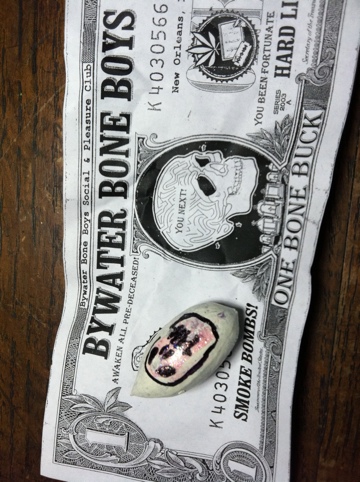
Bywater Bone Boys!

Mardi Gras Skeletons dress in deaths head arrays and traditionally are intended to remind us of our own finite lives. New Orleans memento mori -reminders of death. And scare small children of course. The Bywater Bone Boys were up early and we got a coveted hand made throw! More on Skeleton Krewes in general and the Bywater Bone Boys specifically  here.

New Orleans sound: Neville Bros play “Iko Iko” live medley at Jazzfest

This kind of second line rhythm comes out of the New Orleans tradition of the jazz funeral. On the way to the cemetery, the bands play dirges, slow and solemn. But after the internment, on the way out, after they have “cut the body loose” the music abruptly changes as does the mood of the mourners. It becomes raucous and festive, with a second line of dancers following the band as the crowd shifts into a full-on celebration of the life of the departed.

Iko Iko (Jockamo) was written in 1953 by James “Sugar Boy” Crawford. It describes a confrontation between two groups of Mardi Gras Indians. It has been performed, covered and recorded by dozens of artists and has become a NOLA standard. Here the Neville Bros. perform a live medley at the New Orleans Jazzfest 2010. Oh…Cyril is the super-hot one.

Marvelous Mardi Gras Indians in New Orleans

Gorgeous! The comments section under this link is pretty interesting as well…

Great Gay Leathersex Art: Who was Michael Palmer?

This slideshow requires JavaScript.

It measures about 5′ x5′ and used to hang in the Jackhammer, an old Leather bar in San Francisco. The Jackhammer has been closed since 1996 and this painting now hangs in a private home. It is signed “Palmer” in the lower right corner. A quick consultation trip to Brand X antiques in the Castro district secured a last name, a look at a couple of prints on sale for a couple of thousand dollars each, and an awful story. The proprietor told us that the artist’s first name was Michael. He had quite an extensive body of work, most of which he held in his studio. When he died in the middle of the plague years, his mother, horrified by her little boy’s adult proclivities, destroyed everything.

This sort of thing happens too often. Wonderful Willie Walker, friend of this site, and founding member of the Gay and Lesbian Historical Society, used to dumpster-dive the estates of deceased gay men whose “families” would throw away their collections in shame. Walker – a hero to gay historians and a legend among archivists of any stripe. We miss you, you little weirdo.

Western art is built on the bodies of naked ladies. They call it “The Nude.” The ancients understood the beauty of the male body. We understand it. But – and this is for artists and collectors especially – the folks might not. Make wills, make bequests, make sure your lover has power of attorney, give gifts to the young gays and make sure the good stuff gets into good hands. Generations coming up will need their history. We are making it now and it is our responsibility to make sure it survives.

Meantime, any information on Michael Palmer, gay artist living in San Francisco in the 1980’s would be much appreciated.

For a bit on  Chicago-based artist Etienne, click here.

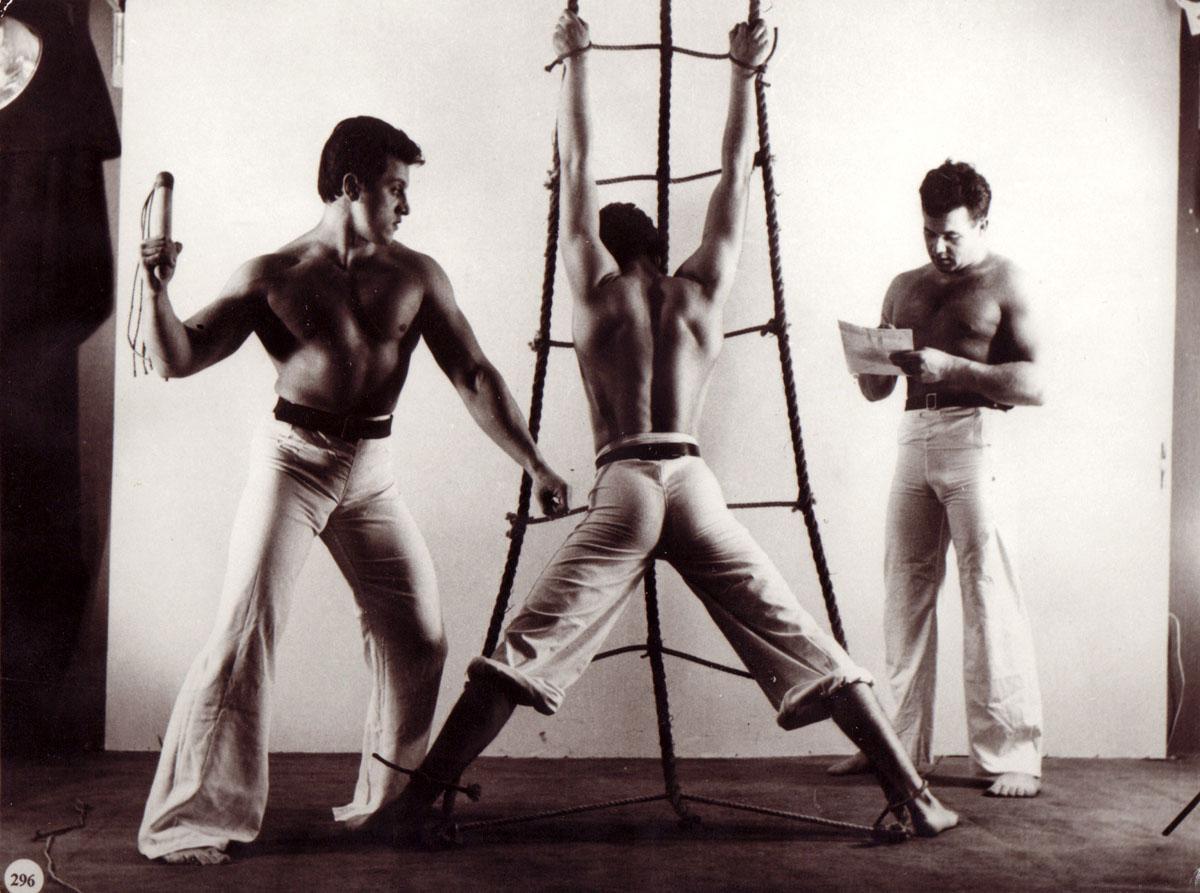
Flogging the Peg Boy! Sexy Sailors from London’s Studio Royale.

Another interesting vintage photograph. From Studio Royale of London.* It’s got that mid-century film still thing going on and a nice reference to the old law of the sea. Whether in the legitimate Navies or their pirate shadows authority condensed into the will of a single man, the Captain, and was enforced by, among other things…the sting of the lash.

For another mid-century photo, this one of mysterious provenance, click here. For more on homoeroticism on the high seas, check out Hans Turley’s Rum, Sodomy and the Lash: Piracy, Sexuality and Masculine Identity. NYU Press, 1999.

*Thomas Waugh. Hard to Imagine Gay Male Eroticism in Photography and Film from Their Beginnings to Stonewall, New York: Columbia University Press, 1996, page 256.

Febe’s “Leather David” Sculptor Mike Caffee at the Powerhouse

Leather David Home and Bath

History in the bars! In 1966, artist Mike Caffee created the iconic “Leather David [that] became one of the best-known symbols of San Francisco leather. [It]  appeared on pins, posters, calendars, and matchbooks…and plaster casts”*

Forty-five years later, Caffee is still on Folsom St., now at the Powerhouse, where he will be presenting a slide-show in conjunction with Forever Folsom, Jose Guevara’s Valentine’s Party at The Powerhouse 1347 Folsom Street San Francisco. 7-10 pm. Sunday, February 13th, 2011. For more, click here.

*Gayle Rubin, excerpted from “The Miracle Mile: South of Market and Gay Male Leather, 1962-1997″ in Reclaiming San Francisco: History, Politics, Culture (City Lights: 1998)