
Tag Archives: Art

Curator Jonathan D. Katz Statement on Smithsonian NPG censorship of Hide/Seek exhibit

On the scandal at the Smithsonian:

Statement from Jonathan D. Katz, co-curator of the National Portrait Gallery’s Hide/Seek:Difference and Desire in American Portraiture.

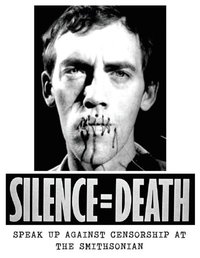
I curated, with David C. Ward of the National Portrait Gallery, the groundbreaking exhibition Hide/Seek. Sadly, I was not consulted when the Smithsonian elected to censor a work by David Wojnarowicz, and then redoubled that insult by referring to “AIDS victims” in their statement—employing the very victimizing locution Wojnarowicz fought with his dying breath to oppose. (Ward was “consulted” but his objections were ignored.) An exhibition explicitly intended to finally, in 2010, break a 21-year-old blacklist against the representation of same sex desire in America’s major museums now, ironically, finds itself in the same boat. In 1989, Senator Jesse Helms demonized Robert Mapplethorpe’s sexuality, and by extension, his art, and with little effort pulled a cowering art world to its knees. His weapon was threatening to disrupt the already pitiful Federal support for the arts. And once again, that same weapon is being brandished and once again we cower. When will it be time for the decent majority of Americans stand against a far-Right fringe that sees censorship as a replacement for dialog and debate? There are larger principles at work, and generations hence will judge our actions today.

This is a culture war we did not seek out, nor start. But appeasing tyranny has never worked and can never work, for tyranny wants only obedience, and blind obedience is antithetical to what this nation stands for; we were, as a people, born in protest to tyranny. Were the men and women whose portraits grace the National Portrait Gallery able to take a stand, I have little doubt they would line up behind the separation of Church and State, enshrined in our Constitution, that this incident calls so painfully into question. Furthermore, they would readily agree that America’s core value, also enshrined in our Constitution, is our freedom of speech. With this as our defining principle, it stands to reason we will disagree, but our disagreements are healthy, even necessary to achieving a genuine democracy. We should be promoting this national conversation, not killing it. Art in general, and this kind of art in particular, is precisely a spur to conversation and to thought–something all civil society should support and celebrate. But when the Smithsonian, under pressure to be sure, starts bowing to its censors, it abrogates its charge as our National museum. But let’s also not lose sight of the fact that the National Portrait Gallery alone had the courage to defy a shameful silence that every other institution in the US upheld. We can not and should not leave them hanging. Where are our democratic Representatives when we most need them to be battling this naked power grab by a resurgent Right? Please write your Senators and Congressional Representatives and urge them to stand against Boehner, Cantor and their calls for a police state. We must nip this in the bud lest 2010 become the 80s all over again.

Over a century and half ago, Walt Whitman wrote, in support of precisely the core values currently under threat:

Unscrew the locks from the doors! Unscrew the doors themselves from their jambs!

Whoever degrades another degrades me, And whatever is done or said returns at last to me….

Through me forbidden voices, Voices of sexes and lusts, voices veil’d and I remove the veil, Voices indecent by me clarified and transfigur’d.

We sought to remove a veil and in opposing that move, our enemies have damaged our democracy once again. I pray it is not another 21 years before someone else tries to remove that veil again. I am sad for us all.

Jonathan D. Katz, Director, Visual Studies Doctoral Program, SUNY Buffalo
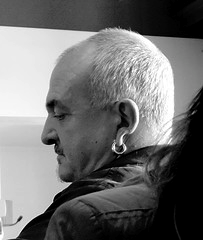
RIP: Peter “Sleazy” Christopherson. Influential Gay Industrial Music Pioneer dies in Thailand at age 55.

Peter "Sleazy" Christopherson

British-born industrial music pioneer Peter “Sleazy” Christopherson has died in Bangkok, Thailand at the age of 55. With Genesis P-Orridge, Chris Carter and Cosey Fanni Tutti, he was one quarter of the influential early industrial music / performance art ensemble Throbbing Gristle, slyly named after Brit slang for an erection. Christopherson later musical projects included Psychic TV and Coil, which he formed with his partner, John Balance. In addition to music, he was also an accomplished photographer and video director with credits including videos for Marc Almond, Diamanda Galas, Nine Inch Nails and The Rollins Band. Coil’s version of Tainted Love is a beautiful, chilling reworking of the classic through the lens of three decades of AIDS. Christopherson died in his sleep on November 25th, 2010.

Not So Still Life. Richard Bolingbroke at Hayward’s Sun Gallery.

San Francisco watercolorist and printmaker Richard Bolingbroke has a solo exhibit called Not So Still Life at the Hayward Center for the Arts’ Sun Gallery. It opened Friday with a reception and artist’s talk.

Sun Gallery is Hayward’s longest standing non-profits arts organization, with a mission to “enrich the cultural life of our community and promote art as the universal language between cultures, income levels and ages.”

Earlier this year, Bolingbroke produced a short-run volume of his long-term project Rituals and Meditations. More on that and information on how to order it or view it online is available here.

Obama-Rama! Happy 49th Birthday to an American Icon.

This slideshow requires JavaScript.

49 years ago tomorrow Barack Obama was born in Hawaii. 49 years ago today, I was born in California. Being born within 24 hours of the seated president has made for some interesting insights. I know, for instance, that Obama is the first president who does not remember the assassination of John F. Kennedy. At 15 months and change, we were too young. Any older, and we might have memories of the turbulent emotional reactions of those around us. But we were still years from any concept of politics.

Even before he took office, Barack Obama was poised to become the most iconic of American presidents. This promise he has kept. Both his supporters and detractors feed a public that doesn’t seem to get tired of pictures of the most photogenic president since JFK. By now it’s cliché that his was the first “viral” campaign. His face was…is everywhere. TIME magazine photoshopped him into a facsimile of FDR, top-down in a convertible, jaunty cigarette holder in mouth; all rendered in black and white, except for his skin. Perhaps this was intended to emphasize the cut between the historical photographs and the contemporary one. No matter. The first Black president is here literally a “man of color.” His image (almost) alone is printed in CMYK – four color process. During the campaign, Mr. S Leather on Folsom Street sold a poster spoofing Sheppard Fairy’s “Hope” poster. It depicts Obama as a Leatherman, jacket and cap surmounted by the word “Obey.” Political cartoonist Lalo Alcaraz pictured him as George Washington. On-line Photoshop® contests inspire amateur commentators from throughout the political spectrums. His altered photographic image circulates in various formats as Abe Lincoln, Che Guevara, The Marlboro Man, Uncle Sam, The Terminator, St. Francis of Assisi and Run of Run/DMC. This latter, on a t-shirt, features a caption reading: “Run DC.” Running shoes are printed with his likeness. One brand features both his face and a caption stamped into the soles so the wearer can leave messages in the sand. The caption reads: “A Black Man Runs and a Nation is behind Him.” Where will those footsteps lead? How will the new president’s photographic image continue to be deployed in this new world, this new millennium? What is the relation between the man, the representation of the man and the nation he represents? No easy job to be so “in focus” in a world that is increasingly “a picture.”

19th c. Technology 21st c. Subject Matter: Artisanal Photographer Eric Robinson to shoot SF Leather

Eric Robinson takes the techniques of photography back to its roots. He works in wet plate collodion processes, producing one of a kind plates on glass. Using a traditional view camera, he cuts an anachronistic figure while exposing the plates. No shutter, he lifts a sliding door on the camera to expose the plate and counts. One, two, three…twenty-nine, thirty seconds or more. A portraitist, his subjects experience a taste of the early sitter’s experience. It is important to stay still. The help of devices may be sought. Portraiture at its best is a collaborative process, an agreement between the photographer and the model. What began in the midwest as a series of portraits by a graduate student of his professor and his partner has become the focus of a cross-country road-trip to document a lifestyle, a subculture, and the extended family of a friend and rogue scholar. On the road somewhere in Nevada as of this posting, Eric should be arriving in San Francisco sometime late Friday, in time for many of the festivities associated with the Dore (Up Your) Alley street fair. Read more about Eric at the HomoGenii site. The photos in the slide show below were taken during a shoot in April, 2010 in Carbondale, Illinois, where the photographer is taking an MFA in Mass Communication and Media Arts at Southern Illinois University. His undergraduate degree is in Chemistry.

This slideshow requires JavaScript.

Rituals and Meditations: Personal Archetypes of Myth, Magic and Beauty from Richard Bolingbroke

San Francisco artist Richard Bolingbroke has just finished his self-published book of watercolors called Rituals and Meditations: Personal Archetypes of Myth, Magic and Beauty. The beautifully produced edition features the artist’s introduction and commentary on all the works, and essays by David Duckworth, John Mendelsohn and Jordy Jones. The book is available to view on-line and for purchase in hard or soft cover versions here.

A Quiet Revolution at Oxford with Fluxus Pioneer Yoko Ono

Fluxus Pioneer Yoko Ono talks about god, chaos theory and quantum entanglement – without ever using those words.

An excerpt: “So now I call ourselves the small pebble people. Send small pebbles to the world. Don’t make big splashes with large stones. That will attract people and the wrong people as well. Our quiet revolution will not make announcements, but one day will be accepted by all people as the norm of life. The human race has done that with many things. Like we wanted to fly, and invented aeroplanes. We wanted to see the other side of the moon, and we have. This time, we want to heal our planet, and bring peace to this world. We can do that.”

The full text of her speech, A Quiet Revolution, delivered on March 10th at Oxford University, can be read here.